Tuesday, 19 October 2010

Snuggle Bunny


D&G Autumn/Winter 2010

When times are hard we all crave a bit of comfort. Everyone knows the feeling: you're stressed by work, it's pouring with rain or perhaps you're just having one of those days. Suddenly all you want is mashed potato and gravy, a big hug and a warm duvet to curl up in.

It seems designers understand that feeling too. Tear out page 'No Pain No Gain' from the fashion rule book because this winter the tables have turned. Being comfortable has never been so chic.


D&G Autumn/Winter 2010

If stressful days drive me to the mashed potato it seems a global recession sends designers running for the comfort blanket. The Autumn/Winter shows were awash with all things snuggly. At D&G cheery reindeer motifs and snowflake prints covered chunky belted knits and fluffy snow boots warmed the models' feet.

Just a few weeks ago Selfridge's was invaded by a flock of Selfridge yellow sheep and Savile Row became a grassy field for the day as part of Woolmark's 'Campaign for Wool'. Over recent years the demand for wool has fallen dramatically, hence the campaign launched by Woolmark.

With D&G on the case however, they really shouldn't worry. Wool suddenly looks far more desirable already.

Chanel Autmn/Winter 2010

Besides from warmth this trend is to me about one thing and one thing only: cuddle factor. And what is more cuddly than a fluffy teddy bear?

Fur is having its heyday. As the nights draw in wrapping oneself in fur seems the only way to beat the winter blues. What better way to make life seem brighter than by wearing a hug?


Chanel Autmn/Winter 2010


Oh but did I mention this is all about faking it? After a Chanel collection entirely dedicated to faux-fur Karl Lagerfeld has deemed the real deal demodé. Now you can keep the cuddle factor whilst being right on trend and maintaining a clear conscience at the same time.

If you fall within the vast majority of the population, meaning D&G and Chanel lie beyond the reach of your pocket, fret not. The high-street is heaving with affordable alternatives to transform you into a stylish snuggle bunny.
I very very nearly bought this coat (£69.99, Zara). I tried it on initially as a joke. I wanted to look like a yeti. However, as soon as the white shaggy number was on my back I never wanted to take it off. Not only was I warmed from head to toe, but I felt instantly and extravagantly fabulous. Such was the feeling when I wore this coat that I was tempted to part with £70. That is, until I read the care label that read 'no machine washing, no hand washing, no dry-cleaning. Do not get wet.'

I do think there is something ridiculously glamorous about owning a coat you can never wash, but unfortunately I'm not quite that glamorous.

The faux-fur on the collar of this wooly teddy-bear coat (£59.99) is so soft it could be real. Don't worry though, no animals were harmed in the making of this coat.
This frock coat from Miss Selfridge (£90) mixes two of the most tactile fabrics - soft velvet and snuggly faux-fur. Prim and ladylike it just looks just the thing to wear to the theatre. With big fluffy ear-muffs of course.
Capes are big this season so this furry one (£95 Miss Selfridge) is right on the money. Basically like wearing a bear.
Next always used to make me think of mums and that horrible phone book of a catalogue (far too many autumn leaves and sickeningly happy children). Recent seasons, however, have seen a turn-around for the high-street giant. I no longer feel embarrassed shopping in Next, and could have very easily got carried away in the Westfield's shop near to my college. I love this cropped cream jacket and it's a snip at £30.

There is nothing quite like the good old fashioned jumper. Whether it's pretty and girly...

Stripey, soft and oversized...

Fluffy and tactile...

A chunky cable knit like the jumpers grandad used to wear...
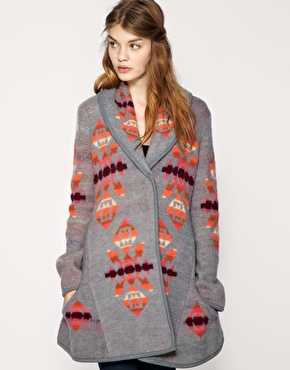
Bright and blanket-like...

Just plain cute...

Fringed boho...

Caramel teddy bear...

A cardigan for the alpine slopes...

Gentlemanly chic with leather elbow patches...

Hooded for snowy weather...

Or a colourful fairisle cardi.

If that wasn't enough fluffy, furry, snuggliness, then you will of course need the accessories to match...


With all that choice there is no excuse for not snuggling up.

Libby

Friday, 1 October 2010

All the World is a Stage

It can take one tiny shift in the earth’s crust to make mountains move. Sometimes all it takes is one visionary to shake up the world. At the end of the 20th Century one such man took an outdated, dusty art form and transformed it into an intensely vibrant, innovative and provocative spectacle that would go on to capture and inspire generations to come. Sergei Diaghilev brought ballet back to life.

The V&A’s major exhibition ‘Diaghilev and the Golden Age of the Ballets Russes’ marks 100 years since the ballet’s first London tour, and charts the history of a theatre company like no other. Master of this company was Diaghilev himself; impresario extraordinaire who has gone down in history for his phenomenal influence not just on ballet, but on the entire arts industry.

Walking through the exhibition it became clear that costume played a vital role in Diaghilev’s reinvention of ballet. Showcased alongside original letters and sketches as well as film clips and paintings are 65 original Ballets Russes costumes that steal the show. Spotlighted in a darkened room: the mustard and gold brocade jacket of Swan Lake’s Prince Seigfred and the Queen’s red velvet dress with a trailing hem and seaweed shaped fronds dripping from the sleeves. Costumes are a riot of pattern and colour and fabrics are enwrought with metal threads, glass beadwork and opulent pearls.

Russian heritage was infused into everything Diaghilev’s Ballets Russes did, from the steps they danced, to the music they danced to, to the costumes they wore, a decision that was not just stylistic, but political. When the Ballets Russes first formed in 1909 Paris was the cultural hub of the world. A few of Diaghilev’s spectacular shows later and the influence of the Ballets Russes could be seen throughout the world, bringing Russia not just acclaim, but power. (To me, a student at the University of the Arts of London, this clear showcase of how art can equal power felt particularly relevant in light of the 25% cuts planned for all arts courses at university level. Looking at the history of the Ballets Russes and the enormous impact Diaghilev’s company had makes me despair at the continued undermining of the importance of the arts.)

It is hardly surprising that the costumes of the Ballets Russes were so resplendent in their brilliance; they were designed by stars. From Poiret, to Bakst to Coco Chanel, Diaghilev’s costumes sparked fashions at the time and continue to inspire designers to this day. In 1976 Yves Saint Laurent designed a collection in homage to the Ballets Russes, many outfits of which are displayed in the exhibition.


The kaleidoscope collection was an aptly glorious tribute to the splendour of the original Ballet Russes costumes. Case in point: high-waisted mustard trousers littered with colourful sequin stars and paired with magenta heels and a hot pink cropped jacket glimmering with yet more sequins. The look was topped off with strings of chunky jewels and a mustard hat with tumbling red tassels. Diaghilev’s riotous harlequin prints and clashing colours were there, but so were hints of the theatre itself. Heavy velvet hung like theatre curtains and rich reds and golds conjured images of cushioned seats in the royal box.

Although the original costumes were a feast for the eyes, it was the Yves Saint Laurent collection that really set my heart racing. Despite the outlandish shades and opulent fabrics these were clothes to be worn and loved by a woman, not dramatic costumes for the stage. Looking at the intricate detail or sheer explosion of colours on many of the Ballets Russes costumes, I found it difficult to imagine them worn by dancers. Playing in the exhibition was a short film of two different versions of Diaghilev’s ‘The Rite of Spring’: a flamboyant, highly colourful reproduction in the original Ballets Russes style, and a second version performed by the Pina Bausch Dance Theatre of Wuppertau. Although the first was visually exciting, the second, with its minimialistic set and costumes, was to me the more beautiful. In the second film the beauty was in the ballet. With all colourful distractions stripped away what remained was an almost painfully expressive, pure art form that pricked tingling goose bumps on my skin. It left me wondering what is the more powerful: a spectacle that involves a collaboration of art forms, or whether art is in fact more poignant in its purest state. Is it even possible to strip music, art or dance to their very essence or are they inescapably linked? What is dance without music, or fashion without art?

More recently Diaghilev’s Ballets Russes lent inspiration to Erdem’s latest collection, showcased a few weeks ago at London Fashion Week. Unlike the jewel tones of Yves Saint Laurent’s more literal interpretation, Erdem’s ballerinas are ghosts from the Ballets Russes. Here Diaghilev is merely a shadow in the shape of lace up ballet shoes, or a whisper in flared dancer skirts.

Naturally dancers seek continual fuel for their work from Diaghilev. The English National Ballet celebrated the Ballets Russes centenary year with famous Diaghilev productions from ‘Les Sylphides’ to ‘The Rite of Spring’. Choreographer David Dawson drew inspirtation from Diaghilev’s ‘Afternoon of the Faun’, re-interpreting it for a 21st audience, opting for a simple aesthetic and music (using just two pianos instead of an orchestra) to create an intimate, expressive production. As the years pass the Ballets Russes may drift further and further into a memory, yet new generations continue to fall for the allure of Diaghilev’s work, bringing new insights and interpretations to light that not only keep the Ballets Russes alive, but transform it for new audiences.


It often takes shocking works of art to stir real change. Diaghilev was a man of change and his productions, therefore, were often met by shock as well as wonder. The Ballets Russes pioneered brave new art forms, from the cubist costumes of Pablo Picasso to radical scores featuring sounds from real life (typewriters, ship horns...) that fell on bewildered ears. The famous ‘Rite of Spring’ caused riots when it was first performed: a shocked and angry audience heckled the performers. Yet this was exactly the reaction Diaghilev wanted. Think of all the shakers and movers in the arts that have caused debate (Damien Hirst’s formaldehyde sheep spring to mind) and you will see why: not only does shock get people talking, but it can in fact cause people to redefine art.

Despite the enormous critical acclaim Diaghilev received and the immense popularity of many of his shows, the Ballets Russes was a financial disaster, relying on donations from rich society figures (including Coco Chanel who as well as designing costumes for the 1924 ‘Le Train Bleu’ personally funded the entire reproduction of ‘The Rite of Spring’. Interestingly Chanel and the ballet have been linked more than once: in 2009 Karl Lagerfeld designed the costume for the English National Ballet’s performance of ‘The Dying Swan). Diaghilev became close to bankruptcy on numerous occasions, not only faced with the devastating effects of the First World War, but in light of the decadent and hugely expensive costumes and set designs that went in to a Ballets Russes production. This raises the ever relevant issue of critical acclaim versus commercial success, a question that crops up time and time again when it comes to fashion and art. Perhaps the most obvious link would be to haute-couture, an art form potentially at risk of dying out due to its precarious financial credibility. If no one buys couture does that make it irrelevant? Similarly if a theatre company cannot cover its costs and fill seats does that make it a failure?

I am normally one for fighting the corner of commerciality. Although wearability can often bring a designer turned up noses from the inner fashion circle at the end of the day fashion is a business. However as I walked around the V&A’s Diaghilev exhibition I changed my mind. Seeing such an extensive display of one man’s impressive life’s work and the way in which it shook up not just ballet, but fashion and art made me realise how essential true artists like Diaghilev are to our society. Diaghilev rewrote the rules and caused a cultural revolution, just like couture designers continue to ignite the hearts and minds of artists and fashion designers, despite battling against all the financial odds. It would be a great shame if the arts industry lost forms as beautiful as couture or Diaghilev’s Ballets Russes. But more importantly I think we would all be at risk of losing so much more.

Libby


Colourful costumes for the female dancers in 'The Rite of Spring', designed by Nikolai Roererich
Designed by Léon Bakst this intricate costume was worn by a Marquis in 'The Sleeping Princess'.
Chanel designed these wool swimsuits for 'Le Train Bleu'. Coco Chanel was one of the first designers to use theatre as a platform for her designs and to understand how it could act as a means of publicity, in a similar way that designers of today use the red carpet to showcase their work. Her work for Diaghilev went on to inspire her own collections.
Karl Lagerfeld's interpretation of 'The Dying Swan's tutu for the English National Ballet.
Pablo Picasso's cubist costumes for the production of 'Parade' changed the way people thought about not only what was possibly of costume, but what could be done in art too.
For Erdem Moraglioglu's Spring/Summer 2011 collection he was inspired by the time he spent behind the scenes at the V&A in the build up to the Diaghilev exhibition.